

![[EP08] A Beginner's Guide to Media Monitoring and PR Reporting](https://static.pulitzer.ai/homepage-blog/3350/2026/05/29/161804_2e3599f5-3b72-4f91-be0b-b265fb6de9b5/61.jpg)
[EP08] A Beginner's Guide to Media Monitoring and PR Reporting
New to PR in Korea? Learn how to track your coverage, check whether your key messages landed, and turn clippings into a performance report that actually means something.
PR Study for Beginners — EP08
In the last article, we covered the editorial pitch: what it is, how to structure it, and why it needs to be handled very differently from a press release. This time, we're shifting to what happens after coverage runs — how to monitor it, what to look for, and how to turn that information into something useful.
All that effort only pays off if you're paying equal attention to what comes out the other side. Which outlets covered it? Did the story reflect your key message? Is anything being reported in a way that could hurt your reputation? Keeping a close eye on coverage is one of the most important and most overlooked parts of PR. 😊
1. Why media monitoring matters

ⓒChatGPT
There are four core reasons to stay on top of your coverage.
Proving the work. Coverage that isn't documented might as well not exist — at least internally. Building a clear record of what ran, where, and in what tone is how PR professionals demonstrate their impact to the rest of the organization.
Checking whether your message got through. Journalists rewrite and reframe press releases according to their own editorial standards. The story that runs isn't always the story you intended to tell. Monitoring lets you see what actually reached readers — and flag it when the gap is significant.
Catching negative coverage early. A factual error, a critical angle, or a misrepresentation that goes unnoticed can quietly damage a brand's reputation. The faster you spot it, the more options you have to respond.
Tracking the broader landscape. Coverage monitoring isn't just about your own company. Watching how competitors and industry trends are being covered gives you the raw material for your next editorial pitch — and keeps you attuned to what journalists in your space are paying attention to.
2. How to clip your coverage
Manual clipping involves searching for your company's name and related keywords directly on news platforms and compiling the results yourself. For startups or companies with modest coverage volume, this is a reasonable place to start — no cost, and a human eye can catch nuances that automated tools miss, including articles that reference your company without naming it directly.
Cast a wide keyword net: company name, English name, brand names, product names, executive names, and common misspellings. The main downside is time. Manual clipping is labor-intensive, and things get missed. A few free tools can help fill the gaps:
Google Alerts sends an email notification when a new article matching your keyword is indexed by Google News. It won't catch everything — Korean portal news in particular can be inconsistent — but it's a useful supplementary signal.
BIGKinds, run by the Korea Press Foundation, gives free access to a wide range of Korean outlets including major dailies, business publications, and broadcasters. The catch is that it requires manual searching each time.
Automated clipping becomes worth considering once your coverage volume reaches a point where manual methods start breaking down. Professional clipping services offer more comprehensive collection, real-time alerts for negative coverage, and typically include licensing arrangements that allow broader use of the clipped content.
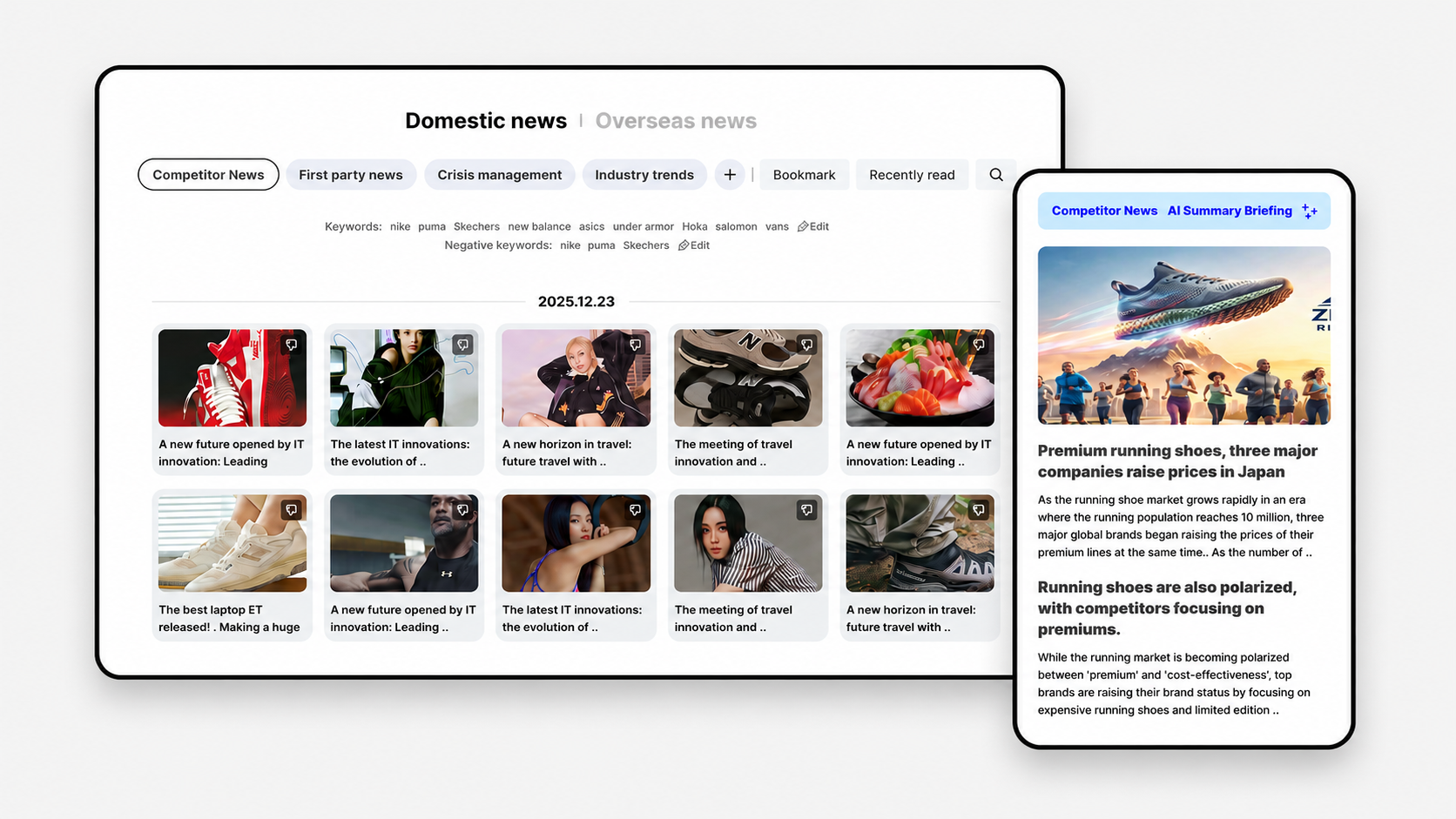
Pulitzer AI's news clipping feature automatically collects and summarizes coverage based on the keywords you set — your company name, competitors, industry terms — across both domestic and international sources. Major outlets like Bloomberg and Yahoo Finance are included, with translation provided for non-Korean content. Sentiment analysis flags potential issues before they become crises. If you want to narrow the focus, thematic clipping lets you monitor only the topics most relevant to your work. 💡
Want to stay on top of your industry without the manual work? Try Pulitzer AI's news clipping feature. 📰 ➡️ Explore Pulitzer AI
3. What to check when you read your coverage
📌However you collect your clippings, three things are worth reviewing every time.
Key message alignment: Did the story reflect what you were trying to say? If the coverage missed your central point or framed it in a way you didn't intend, a brief, polite follow-up with the journalist is worth considering.
Tone classification: Tag each article as positive, neutral, or negative. The same announcement can land very differently depending on how it's framed, and tracking tone over time helps you identify which outlets tend to be favorable and which tend to be critical — useful context for future pitching.
Factual accuracy: Errors in financial figures, executive names, or product details appear more often than you'd expect. Anything involving financial data is especially sensitive, given how markets can react. When you spot an error, contact the journalist promptly and request a correction.
For high-stakes stories or in-depth features, it's worth reading the full article yourself rather than relying on a summary. Understanding the full context of how your company is being covered — not just whether it appeared — is what separates reactive PR from strategic PR.
4. Turning clippings into a performance report
Media monitoring only delivers its full value when the data is organized and reported on regularly. Clippings collected but never synthesized are just a stack of links.
Most PR teams work with two types of reports.📝
A daily clipping report shares that day's relevant coverage with leadership and key internal stakeholders — your own articles, competitor news, and notable industry developments.
A monthly or quarterly performance report takes a broader view of PR activity and outcomes over time.
For a performance report, these are the metrics worth tracking:
Total coverage volume for the period
Outlet tier breakdown (major nationals, trade press, regional, etc.)
Tone distribution across positive, neutral, and negative
Press release conversion rate — what percentage of distributed releases resulted in coverage
AVE (advertising value equivalent) — the cost of equivalent ad space, useful as a supplementary metric but not a substitute for qualitative analysis
Categorizing coverage by type adds another layer of insight: was the article based on your press release, or independently reported? Was it neutral coverage, a critical piece, or a competitor story that mentioned you in passing?
On format: keep executive reporting and working-level reporting separate. Leadership needs a one-page summary — two or three key issues, a reputation snapshot, competitor highlights. The PR team needs the full details. Mixing the two serves neither audience well.
The real purpose of media monitoring
The goal isn't to accumulate links. It's to understand how your company's public presence is being built over time — which messages are landing, which journalist relationships are generating results, and where the gaps are. That body of data is what allows you to communicate more effectively when it matters and respond more quickly when something goes wrong.
Pulitzer AI makes news clipping and performance tracking easier
Pulitzer AI supports the full PR workflow — from press release drafting and distribution through coverage tracking and performance reporting. The platform automatically collects and stores coverage generated by your press releases, and organizes that data into structured performance metrics. News clipping is also available as a standalone service, already in use at companies including Toss, Hyundai Capital, and SOLUM.
Make PR easier, grow better✨
From drafting to distribution to performance tracking, Pulitzer AI covers the full workflow. ➡️ Try Pulitzer AI
What's next
In the next article, we'll cover how to respond to negative coverage and factual errors — a step-by-step process for handling both without losing your footing. Pulitzer AI is rooting for you.💪✨